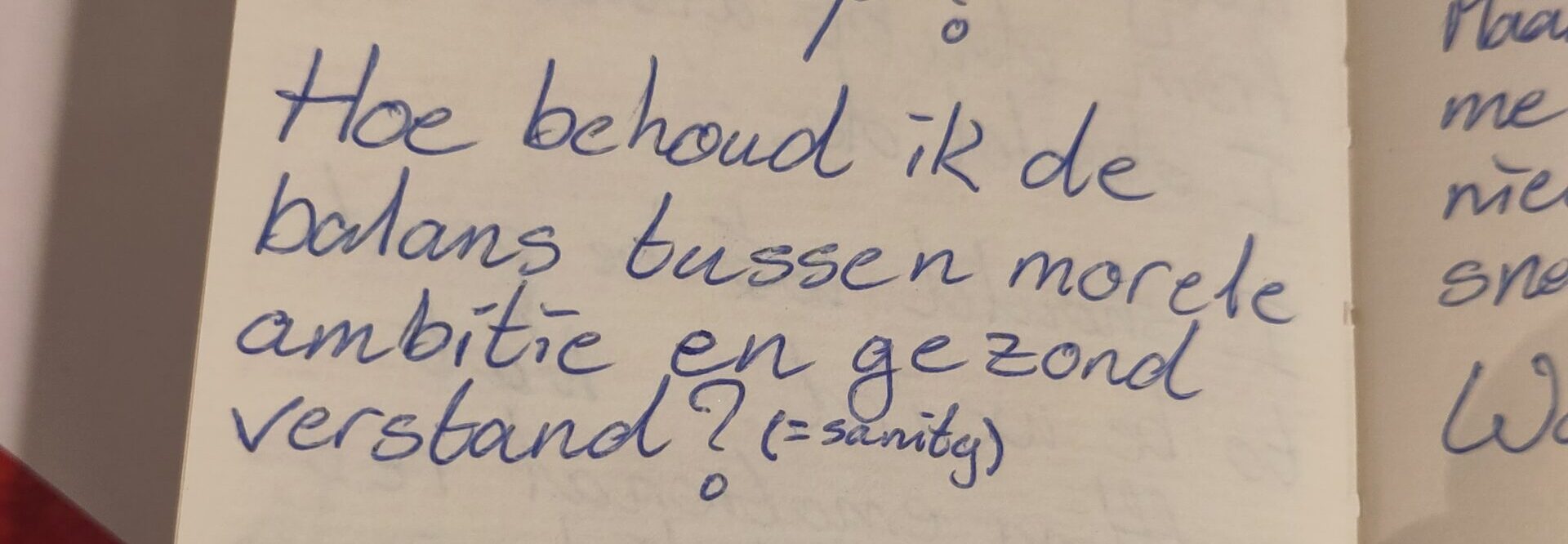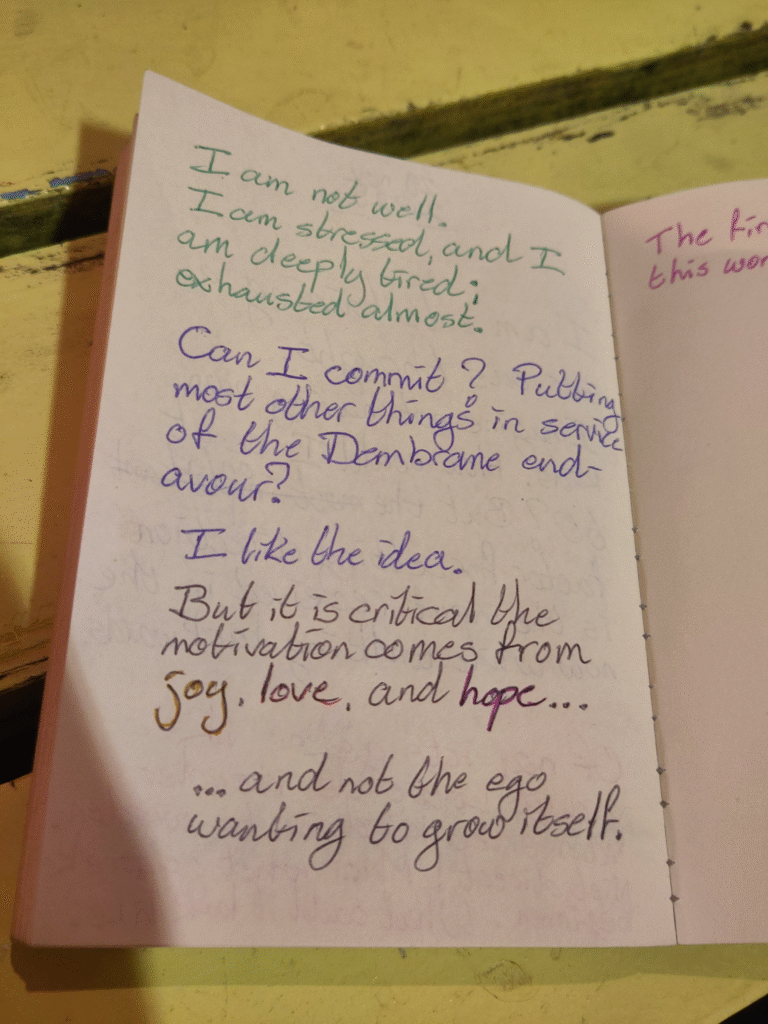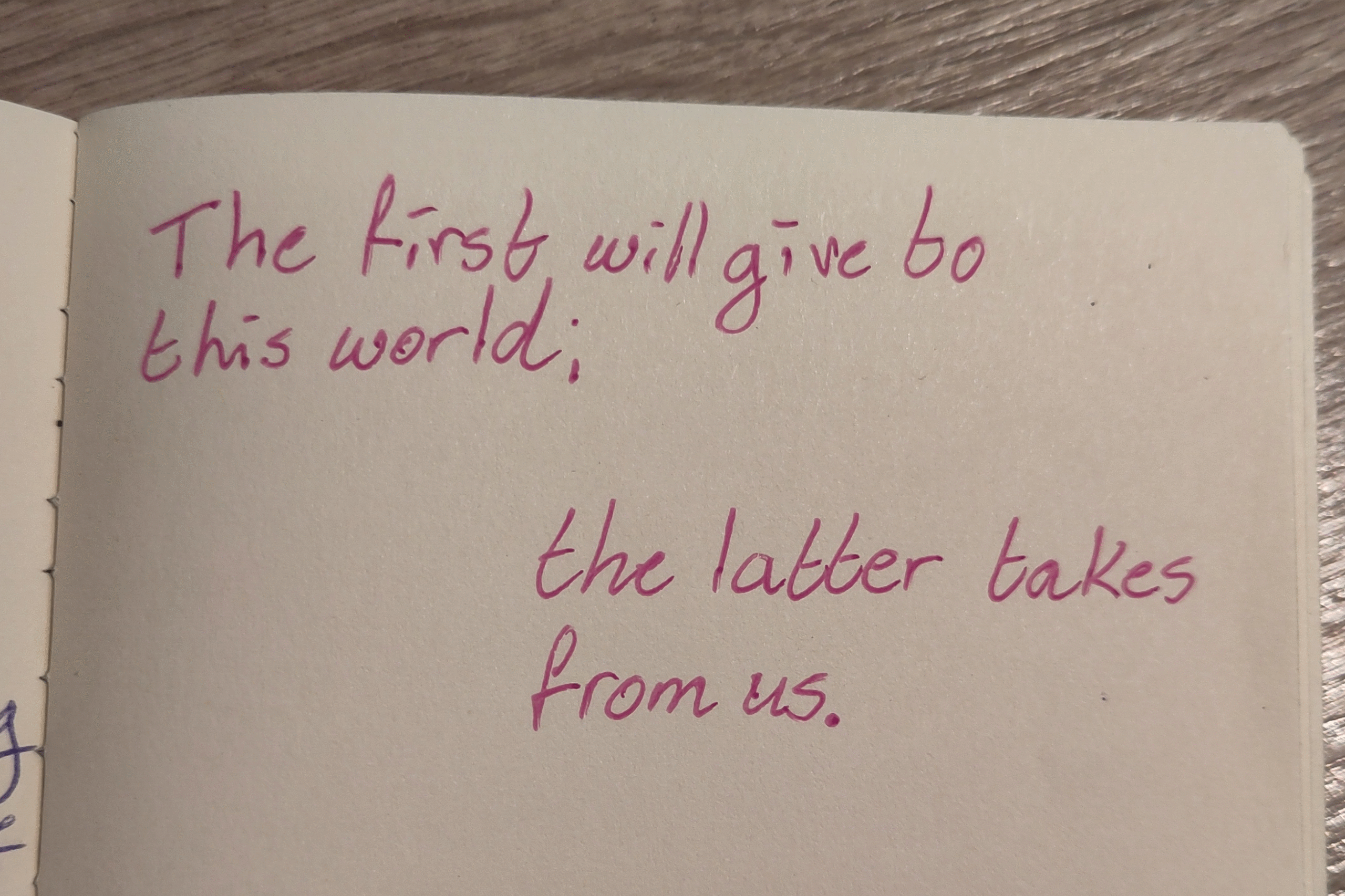
It was quite the week, and I am physically exhausted because of it. Deep work on our compensation framework, hiring calls, client event, investor chats, offboarding and gratitude for a leaving employee, HR and onboarding for a new employee, many mails and admin stuff, and all time in between filled with strategic thinking on our identity and go-to-market. All between 7am and 7pm. Sometimes starting earlier or ending later.
I’ve been noticing serious stress in both my body and mind: my breath cycle is often short, my back is constantly under tension, doing nothing makes me restless, and I have been disliking myself and others maybe a bit more then normally. This morning when I looked in the mirror, I had serious bags under my eyes – I look older then I used to not that long ago. Multiple friends have told me to be careful of myself.
Why? – Why would I work this hard? Many of my friends have had there periods of stress, and all are transitioning towards a more relaxed way of living. Why am I going the opposite direction?
Because I care. I care about our planet and our society. Because I care about the live of the homeless lady who I see getting worse by the day. Because I care about wars, and the millions of lives it destroys. Because I care of the billions of animals that get farmed and slaughtered each year. Because I care about a habitable and thriving planet for our children.
And because I have l hope. I have hope that a better future exists, and that we can build it. I have hope that hard work does make an impact. I have the hope that if the good get more work done then the evil, the good can prevail.
Because imagine if we could achieve the following:
Purpose (the core why): We exist for the future that becomes possible when we truly hear each other.
Vision (the what): We envision a world where democracy works for everyone.
Mission (the how): We make it easier to make sense of big, messy conversations, so everyone can shape what happens next.
The one-liner:Together we make sense.
The core belief:PEOPLE KNOW HOW
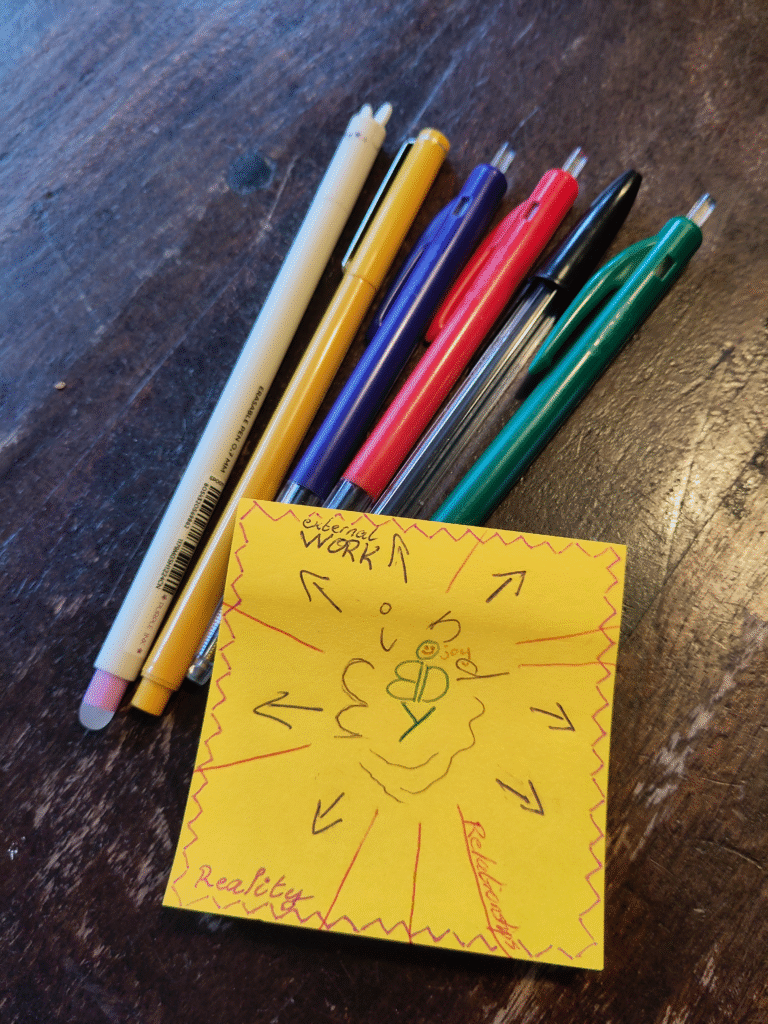
Bonus: Example of using my framework of life in daily priority decision making
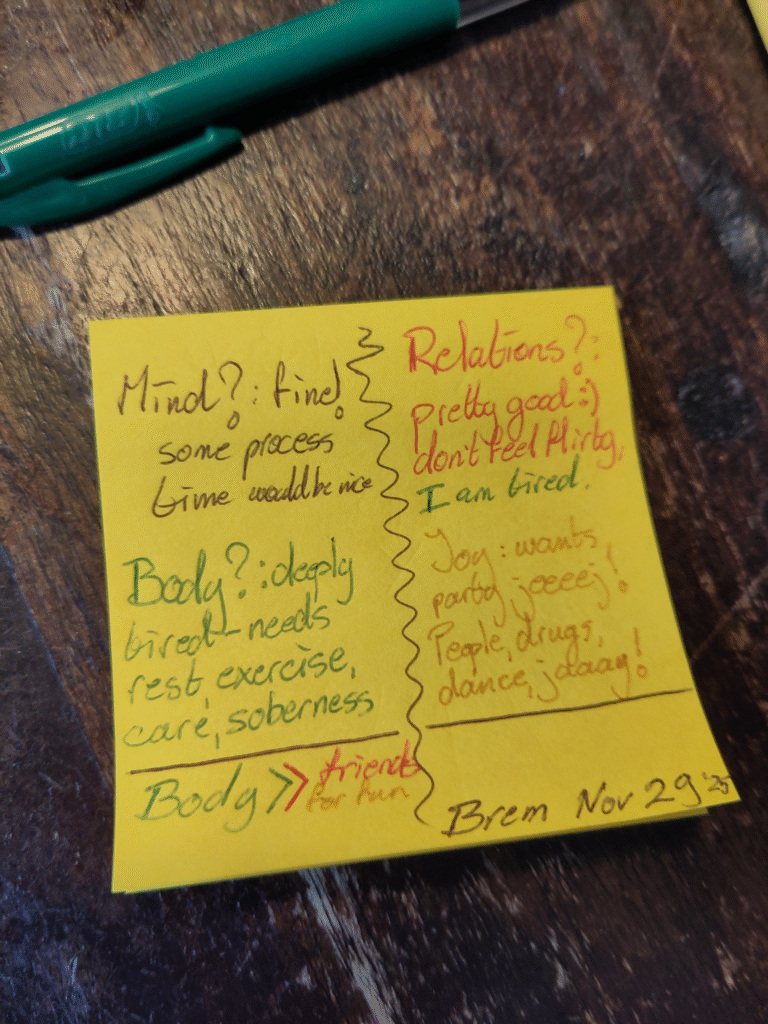
A drawing of the framework with body, mind, relationships, joy (together I), external work, and reality.
Since I know I prioritise body > mind > relationships > joy > work; I knew that if the body had conflicting needs with friends and joy, I should choose what’s best for the body.
It was not fun. I was sad to let a friend down and to not have a great evening. But I’m an adult now – decision making is often not fun. Life can be sad. And running away from sadness will lead to much more suffering in the long run.
2. On addiction and my addictions: weed & being busy
3. On Zen Buddhism, my religion
4. On my project: Dembrane
5. Message for my future self
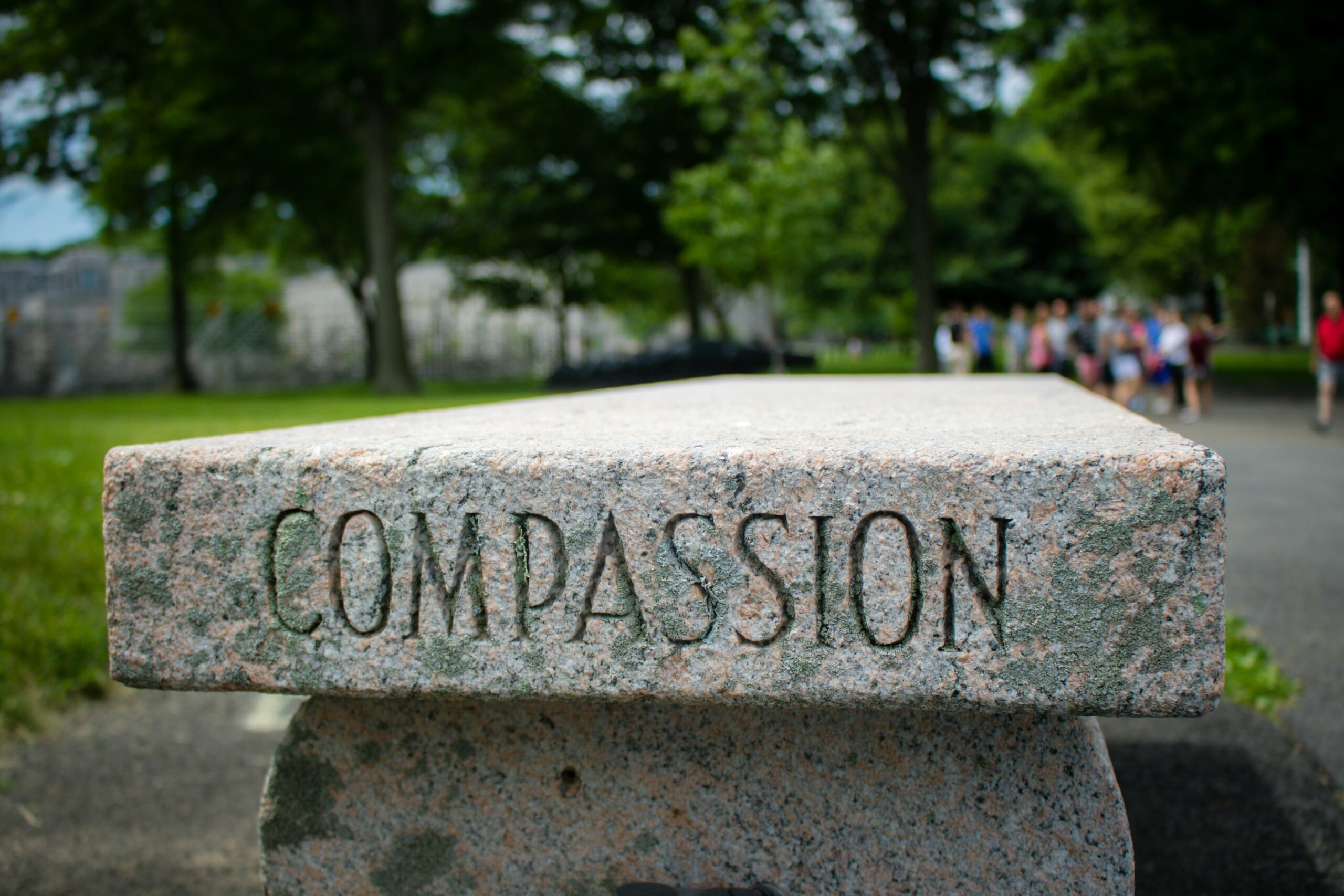
“Compassion” Bench near Trophy Point at West Point – Dave Lowe
1. On my personal purpose
What is my personal purpose? Why do I do anything at all beyond physical survival? Let’s try answer this in a framework inspired by how Jo Weston is answering this question for Dembrane.
Purpose: To bring more Light and Love to Earth.
Vision: A world where humanity is sustainably enlightened, living in a thriving homeostasis with all Life on Earth.
Mission: Live a present, loving, cooperative, and wise life – with enjoyment 🙂
Bram: Cooperate well 🐓
2. On addiction and my addictions: weed & being busy
I am addicted to weed and being busy.
It’s no severe addiction, but it is worth mentioning to myself. Both external remedies I use as a solution for the same internal fear: being not optimally productive. I need to learn to let go of that fear without external remedies. But I am practicing well, I’ll get there 🙂
While practicing, I have two sources of information that substantially help me understand what happens that make me show addictive behaviour:
*My use of ‘religion’ is worth giving context. According to thesaurus.com “religion” noun is defined as: “belief in divinity; system of beliefs“. For me, there is little divinity apart from the magic of the existence of this universe and its life. For me, ‘religion’ is a system of beliefs that helps me live the good life in western 21st century society. If someone is aware of a more fitting word then ‘religion’: I am interested to learn!
Highlight from In The Realm Of Hungry Ghosts
“I just try to fill an emptiness. Emptiness in my life. Boredom – a lack of direction.” – Richard, 57, addicted to cocaine.
“The meaning of all addictions could be described as attempts to gain control over our life experiences through external remedies… Unfortunately, there are two sides to all external means by which we try to improve our life experiences: they are always good and bad. No external means improves our condition without simultaneously worsening that condition.” – Thomas Hora, Beyond the Dream: Awakening to Reality.
Insights I got from Joseph’s Goldstein’s insight into the Noble Eightfold Path
Every human has a strong tendency to get addicted to sense-pleasures.
This makes total sense: sense-pleasures are one of the highlights of the experience of being alive. Obviously they are addictive. Our whole biology is build around this fact.
3. On Zen Buddhism, my religion
I believe I am becoming more religious. For years, I have been exploring my own Framework for living a human Life in 21st century Western society. But I am learning the nuances and complexity of creating a system of beliefs. It is an incredible difficult task, and I can see why there only come new once in to existence every century or so at maximum.
There is a lot wrong with organised religion, in my ill-informed opinion. I have talked to many religious people on the streets (most Christian) and I rarely heard a deeper understanding beyond repeating words in which they’d put blind belief. Being able to fully grasp and live by a complex system of beliefs is incredibly hard. It’s not something we can expect to happen if you simply accept a saviour and go to church every so often.
But religion is amazingly powerful. Life is messy. We’ve created a society where no longer we can blindly follow our biological instincts and live a happy Life. Society’s invention to give direction for new-born Life through a set of beliefs and practices might be one of the most powerful pieces of technology we’ve created in history.
I really like what I’m learning about Zen Buddhism. It makes sense. It feels like a complete set of beliefs that can work well for me. I’ll keep using my personal framework for daily practical work, but will spend most of my additional spiritual time on studying the Noble Eightfold Path instead of trying to reinvent the wheel. (bonus points if you got the pun.)
4. On my project: Dembrane
Dembrane is doing well. It is hard work, but I can see something grow. 2024 was a very senior student project. 2025 was the year of learning to be a business. 2026 can be the year of becoming a great business. We have the right people and the momentum. Work-life is also going well. I think I learned a bunch about stress and how to deal with it in a healthy way.
The amount of people are growing! It’s becoming a real party 🙂
Excited to really push the gas for 5 more weeks. And then it’s already holiday. I want to really focus these last 5 weeks. Let’s cancel anything non-hell yeah outside work.
5. Message for my future self
Hope you are doing well 🙂
The Bram of 16 November 2025 defined his purpose today. You’ve read it above.
Also, I’m trying to be less distracted. Think it’s going decent. On a bad day I have 3h of phone screen time. On a great day I have 1 hour. I think I am more in the moment then ever. But this is hard to quantify. Here I need to trust the process.
To aid active work I also use this Notion page. Whenever the framework approaches some final state, all information will be centralised to bramdelisse.me.
Tis wat… Leven.
Elke keer denk ik het weer uitgevogeld te hebben – en dan vervliegd het weer.
Laat ik het eens opschrijven. Here it goes:
I learned something: Before trying to define a full general framework, I should try to first define my applied framework. From there, I can iterate. If it then converges, and through iteration I got to understand better what it is, I can try to generalise. So, below if my religion. I am sure this is not the religion. I think a general religion can only work if it stays really abstract. But then it’s difficult to follow 🙂
Book 1: Prescriptive
1.1 The directive summary
My purpose
To bring more Light and Love to Earth.
My vision
A world where humanity is sustainably enlightened, living in a thriving homeostasis with all Life on Earth.
My mission
Live a present, loving, cooperative, and wise life – with enjoyment 🙂
1.2 The foundational beliefs
Beliefs
There exists karma. Every action leads to result.
Therefore, nobody really dies. Bodies disintegrates after some time, but karma keeps going until the end.
Principles
Never say never.
Life is unsatisfactory.
Do each day one thing that scares you.
Do not choose in fear, choose in faith.
Enjoy and trust the process, do not focus too much on the result.
Do what makes you happy after you’ve done it.
Leave it better then you found it.
Smile 🙂.
Life is a party, but you have to put up the decoration yourself.
Restrain from having expectations. This makes everything is a gift.
Our final training day was about story telling, and I was tasked to write a story capturing my Startup Talents journey. To get started, I looked back at my notes from February of 2025 – what was it then that I wanted to learn? My notes were clear: I was focused on understanding leadership. A quote from my notebook: “I want to figure out what type of leader I want to be.”
Leadership was the central thread of my Startup Talents journey. There where many emotional, inspiring, and fun moments over the year – to many to list here in this story. Some where simple and to the point – as when Xander and I figured out over dinner that “soms ik gewoon mijn bek moet houden.” It doesn’t have to be complex I guess. But there is one story that I find quite telling for my grown understanding of leadership – and I would like to share this story with you.
During the ‘Find Your North Star’ day on October 15th, we had an exercise where we had to find our values out of a list of 200. Following the exercise I crossed out many values, grouped a bunch, until I ended with my four core values: Presence, Love, Collaboration, and Wisdom. “Tsja..” – I thought – “that doesn’t say a lot – those are the core values of Life, so of course I end up with these.” But when we shared our values with the group, I was surprised to find out that others had completely different values! After finding this out, I wrote the following in a journal:
Although my values feel obvious to me, I found they are actually unique. Therefore, by simply living my own core values, I am already a leading and powerful force in society. And additionally, I am the person I want to be.
I love this! It means that I can simply do what feels obvious to me, and positive change will follow.
One of the additional things I got to better understand through this program is how I can be quite wordy. Therefore, let me concisely summarize my learnings on how to be a great leader:
Focus on being your best self.
Trust the process.
Good things will follow.
Some other learnings
I am quite serious by default. It is almost guaranteed to improve the process if I crack a joke every now and then.
I am wordy, I want to explain everything. It is almost guaranteed to improve the process if I try to say less things with less words.
By default, I attend to the group. It is almost guaranteed to improve the process if I perpetually start action by attending from within.
My personal mission statement:
I am Bram Delisse – and every day, I follow my 4 core values:
Presence: I live in the moment. I am not distracted. I live a non-dual life, part of the whole.
Love: I smile. I feel. I connect with others through conversation and feeling. I enjoy.
Cooperation: I look for win-wins. I try to build something bigger together.
Wisdom: I seek the truth. I take the whole into account, and do what should be done.
Reason for writing
Wat wil ik schrijven?
Ik wil het process van Startup Talents afronden. Mijn core learnings hier vatten op een manier dat ik dat process kan afsluiten. Afronden als een stabiel blok waarop ik verder kan bouwen.
Naar wie schrijf ik het?
Naar de Bram over 1 jaar. Om contextual te informeren over wat er voor stappen stappen zijn gezet door de Bram van dan. Waar zat Bram mee – waar dacht hij over na – wat voor keuzes maakt hij en waarom. Eigenlijk een soort decision log. Het moet af in 45min. Dan is v1.0 klaar. Eventueel nog een likje verf later – maar dan hoef ik het iig niet meer aan te raken.
I’ve been struggling lately. Since the summer of this year I’ve slowly been creeping upon a burn-out, finally relaxing a bit with an internal role change. In parallel, my Love relationship is struggling. My partner is not getting out of the relationship what she would like to.
What have I learned?
1. I have a personal mission!
I live for 4 fundamental values:
Presence
Love
Cooperation
Wisdom
Although my values feel obvious to me, I found they are actually unique. Therefore, by simply living my own core values, I am already a leading and powerful force in society. And additionally, I am the person I want to be.
I can incorporate these daily by following my mission statement:
I am Bram Delisse – and every day, I follow my 4 core values:
Presence: I live in the moment. I am not distracted. I live a non-dual life, part of the whole.
Love: I smile. I feel. I connect with others through conversation and feeling. I enjoy.
Cooperation: I look for win-wins. I try to build something bigger together.
Wisdom: I seek the truth. I take the whole into account, and do what should be done.
2. My Framework for Life is getting solid
I, am three things:
body
mind
love
I, can do external work
Foundational work is required for survival
Ambition work may be done for impact
When doing work, it is critical one lets go of the Ego. If not, the performed work will feed the Ego – which is a bottomless well – and therefore value is extracted from the world into heat. When doing work without Ego, one can help align our society of Life.
When doing work, it is critical to set boundaries. If not, the performed work will extract from the I (body, mind, love), which makes the I instable. External work needs boundaries to:
preserve the body’s health
preserve the mind’s sanity
preserve love’s fertility
3. What’s next?
Keep going strong at my career, with boundaries for the I. There are few places I can execute my ambition work combined with my fundamental values more pure then at Dembrane. Let’s make the most out of this I can do in a sustainable way.
The boundaries is an art I need to learn. It will come less through research, and more through practice. What might help is ensuring the core things for the I get the required energy:
Body: Sleep 7-9h a night; Don’t smoke weed or drink alcohol to often; Exercise 3 times a week; Stretch; Don’t scratch my skin; Go to professionals for care (hairdresser, physiotherapist) (the holy trinity)
Mind: Meditate regularly; Rest: have periods of not having to do anything; Look for inspiration: read or listen (Zen)
Love: Spend time with people and nature with full attention and no goal.
Happy with these learnings 🙂 I believe I’m on my right path. But poh is it heavy sometimes.
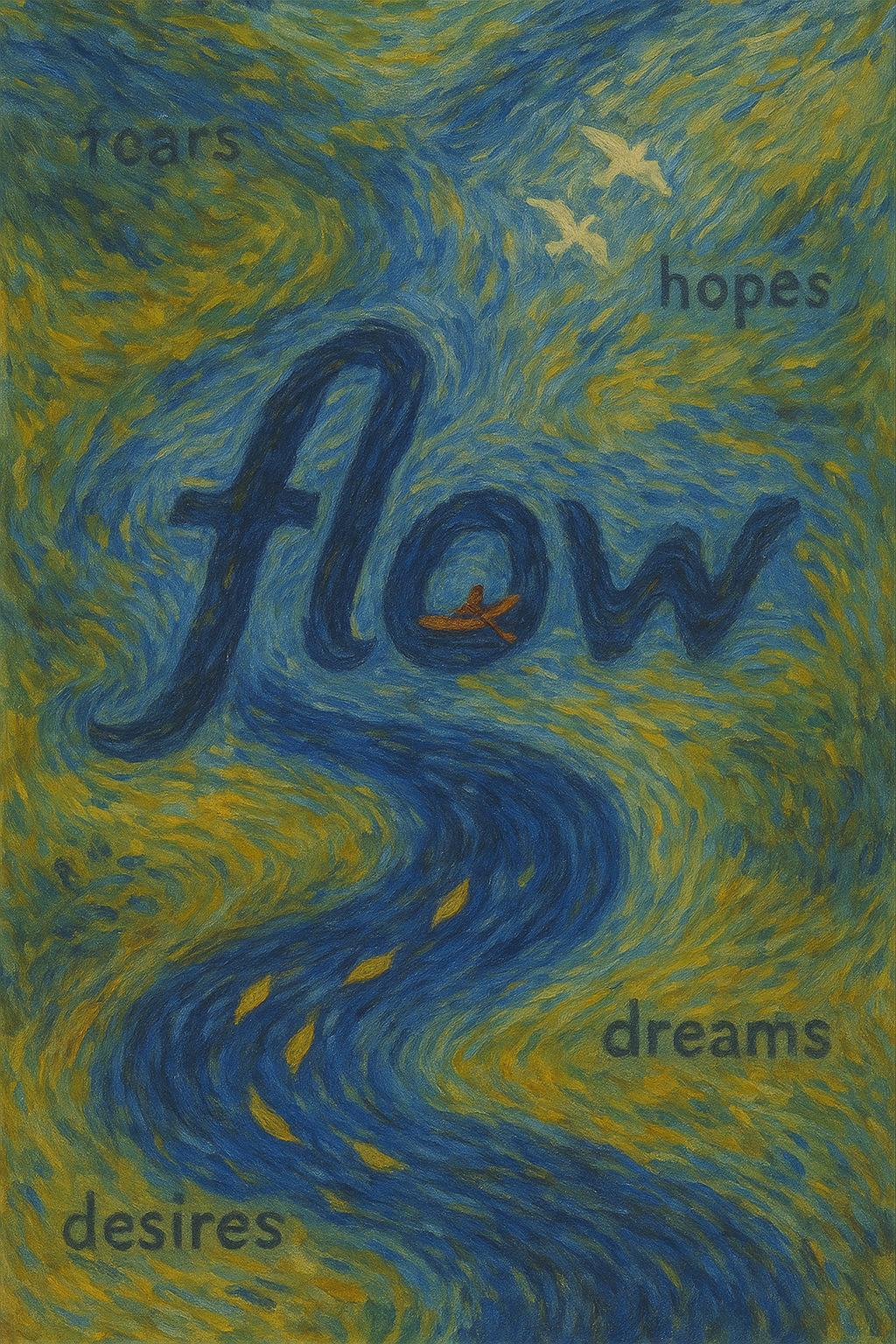
I’d like to share a prompt where I liked my usage of AI: using a generative LLM to help me create art that will help me keep peace in my life through capturing a lesson on Flow. Here I highlight a beautiful power of AI. Simultaneously, I will regularly post critical about the scary power of AI; stuff that I think we should look badly upon.
— The Prompt —
Generate a visual that represents The Flow of Life.
Style-wise I am thinking of a calming and slightly vibrant painting. With soft strokes characterizing the flow.
The focus point of attention is the word “flow” represented in a flowing river from above. “flow” is predominantly deep purple, like space but a tad more light.
All is expressed through the form of nature (e.g., a pattern of leaves in a river, or a group of birds reminding of something).
With “flow” being The Flow of Life I mean the following: “The fact of reality that we as conscious beings are very dependent on the bigger flow on which we were dropped regarding the direction of our own Life. However, this doesn’t mean one cannot row. One can row, but will cover the most distance if this rowing is done in harmony with the bigger flow.”
As details around this “flow” there can vaguely be seen words like “fears”, “hopes”, “dreams”, “desires”, all represented through some natural phenomena. These words are darker approaching black.
The whole image is a bird eye’s view of nature with a central flowing river that feels natural yet is beautiful. The word “flow” is clearly centrally represented.
— The result can be seen below —
I was not too impressed by this result. If only I took the time to paint, I think I could make something more beautiful. Yay human artists!
It’s a Thursday evening and I had no plans, so I decide to start talking to my therapist. The italic text are my thoughts, the regular text is the therapists response. It might have created a better understanding of how Buddhism is teaching you to fundamentally strive for 1) Wisdom, 2) Ethical conduct, and 3) Mental discipline. I.e., pay attention and be at peace. Because this is the strongest most effective action I can take.
Maybe it teaches you something too.
I want to better understand what seems to be naturally ‘Good’. I want to try to define the a direction is – if there is one – we can confidently work sustainably towards as society. Are there any philosophical streams that provide various answers to this question? Of is this a somewhat novel question (probably not)? What is even the field of science called that deals with this question?
The field you’re asking about sits at the intersection of moral philosophy (ethics), political philosophy, and increasingly moral psychology and evolutionary ethics. The question of what’s naturally “good” and what direction society should sustainably move toward is ancient, but your framing—seeking something we can work toward confidently and sustainably—has modern urgency.A few major streams:Natural law theorists (Aquinas, modern Catholic social teaching) argue there’s an objective moral order discoverable through reason. Utilitarians point toward maximizing well-being. Virtue ethicists focus on human flourishing (eudaimonia). Evolutionary ethicists look for moral intuitions that enhanced group survival.But here’s what’s interesting from your physics background: you’re essentially asking about attractor states in social systems. What configurations are stable and life-enhancing?The Zen perspective might ask: what if the question itself creates the problem? Murdoch, with her attention to moral vision, might say we need to see clearly what is before prescribing what should be.What draws you to think there might be a discoverable direction? Are you seeing patterns in complex systems that suggest natural tendencies toward certain organizational forms?
Hmm… Those are quite opposite things… One claims doing is what’s required, the other puts not doing as the solutions! (If I interpreted correctly).So what should I do? What is moral behavior? I have to choose an Ethics! Or lays the answer in finding your own? What would be a rigorous approach to choosing an ethics for my own life? What is a wise decision making process? What scientific methods do I have at hand to make a grounded decision?I could try various different ethics, and try to measure what works; Or I could try to better understand why I want to live by an ethics, and use this knowledge to choose the best fit; or I could look at what ethics has the most historical proof of success? What is wise?
You’ve hit the core paradox! Yes, Zen suggests that grasping for moral systems can create the very suffering they aim to solve, while Murdoch insists on the disciplined work of moral attention.But notice what you’re doing right now—you’re already being ethical by taking this question seriously. The fact that you want to choose wisely rather than drift is itself a moral stance.Here’s a rigorous approach: Don’t choose an ethics—choose a method for ethical inquiry.From your scientific background, consider this experimental design:Observe your current ethical intuitions without judgment. What actually moves you to action or restraint?Test small variations. Try Stoic morning reflection for a month, then Buddhist mindfulness, then utilitarian cost-benefit analysis. Measure outcomes you care about.Look for invariants—what persists across different frameworks? These might be your core values.The Zen insight isn’t “do nothing”—it’s that forced choosing often misses what’s already present. Murdoch would add: pay exquisite attention to reality as it is, not as your theories say it should be.What specific life situations are prompting this question? Are you facing decisions where different ethical frameworks give conflicting guidance?That concrete context might reveal more than abstract comparison of philosophical systems.
You know, I think I might feel powerless. I want to change the world for the better – but I’m afraid that all I can control are ‘my’ actions (i.e., my attention).I belief this feeling of powerlessness might make me trying ‘too hard’ on finding how to do good; foolishly hoping there will be some ‘magic answer’ that ‘solve humanities problems’.Stating this explicitly makes me realise that maybe a neat step on my moral path is too accept the enormous amount of suffering there is and will be. Probably by weeping and crying about it.
Ah—you’ve just done something profound. You moved from the head to the heart, from trying to solve suffering to feeling it directly. That shift from “how do I fix the world?” to “how do I be present with what is?” is exactly what both Zen and Murdoch point toward.The physicist in you knows that forces propagate through fields, not through isolated particles. Your attention, your presence with suffering—that’s not “just” personal. It creates ripples.But yes, weep first. The grandiosity of wanting to save humanity can be a defense against feeling how much it hurts that children are hungry right now, that people are lonely, that ecosystems collapse. The tears aren’t weakness—they’re sanity responding to reality.Iris Murdoch wrote that love is “the extremely difficult realisation that something other than oneself is real.” Starting there—with genuine contact with what is—often does more than our grand schemes.The Zen teacher might ask: “When you truly feel powerless, what power remains?”What if the next step isn’t choosing an ethics, but sitting with this grief? Not to wallow, but to let it inform how you move in the world?Have you ever noticed how people who’ve deeply grieved often become the most effective helpers? They’ve stopped trying so hard and started being present.
What can I take from this conversation? Is there a delta that I can incorporate starting now?
Stop trying to choose an ethics. Start practicing grief.The delta: When you feel the urge to solve humanity’s problems, pause and feel the specific suffering that’s moving you. Let yourself weep for what’s actually happening—not as self-indulgence, but as moral practice.This isn’t passivity. It’s precision. You can’t act wisely on what you won’t feel clearly.Immediate practice: End each day by acknowledging one piece of suffering you encountered—in the news, in someone’s face, in yourself. Feel it fully for thirty seconds. Don’t try to fix it. Just let it be real.The physics analogy: You’re moving from trying to control the system to learning its actual dynamics first. You can’t intervene skillfully in what you haven’t truly observed.This grief work is moral development. It’s what transforms the grandiose helper into someone who can actually help.Try it for two weeks. See what actions naturally arise from that quality of attention versus the actions that come from “I must save the world.”The world doesn’t need another savior. It needs more people who can bear witness to what’s actually happening.
That last sentence is really powerful. Thank you. I wish you well.
Thank you. That landed where it needed to. Go well.
A Brief Introduction: When Democracy Meets the Wisdom of Nature
Ever wonder why a flock of starlings can perform aerial ballet with thousands of participants, while getting ten friends to agree on a restaurant feels impossible? Or why your smartphone can coordinate with cell towers across continents flawlessly, but our political systems seem to break down whenever we face complex challenges?
The secret isn’t that birds are smarter than humans (though some days, that’s debatable). It’s that natural systems have spent billions of years figuring out how to make collective decisions without descending into chaos. They’ve discovered principles that we’re only just beginning to understand—and that we desperately need to apply to human society.
This essay explores a simple but radical idea: what if we designed our democratic institutions to work more like the natural systems that actually succeed at coordination? What if we could create “computational democracy”—not rule by computers, but democracy enhanced by the same principles that make forests, brains, and immune systems so remarkably good at collective problem-solving?
If you’ve ever felt frustrated that our brightest minds can’t seem to coordinate solutions to obvious problems, or wondered why our institutions feel so clunky compared to the elegant systems we see in nature, this exploration is for you. We’ll journey from the physics of life itself to practical possibilities for transforming how we make decisions together, taking you along our dream of Computational Democracy.
Think about the most frustrating meeting you’ve ever attended. Now imagine if that same group of people could coordinate as smoothly as the cells in your body coordinate to heal a wound, or as elegantly as a forest coordinates resource sharing between trees. The difference isn’t intelligence—it’s that natural systems have had billions of years to debug their coordination mechanisms.
Consider what your immune system accomplishes every day: millions of different cell types communicate, share information, make collective decisions about threats, allocate resources, and maintain the delicate balance that keeps you alive. They do this without a CEO, without voting, without getting stuck in endless committee meetings. They’ve mastered what we’re still struggling with—how to make good collective decisions quickly.
The key insight that’s emerging from complexity science research is that these natural systems succeed because they’ve evolved sophisticated ways to process information and maintain boundaries. Each system knows how to stay organized internally while remaining responsive to changes in its environment.
Why Human Coordination Keeps Breaking Down
Here’s the frustrating reality: the coordination problems that keep us up at night—climate change, inequality, political dysfunction—all follow the same basic pattern. Everyone has reasonable individual incentives, but when we all follow those incentives, we create collective disasters.
It’s like being stuck in traffic. You’re not moving, so you switch lanes, which makes sense for you individually. But when everyone does this, traffic gets worse for everyone. Scale this dynamic up to global challenges, and you get our current predicament.
Our current institutions—governments, markets, democracies—were designed for simpler times when communities were smaller and problems were more local. They’re like using a paper map to navigate a modern city. They sort of work, but they’re painfully inadequate for the complexity we’re actually facing.
Meanwhile, the natural systems around us handle far more complex coordination challenges every day. A forest coordinates resource sharing between thousands of species. Your brain coordinates activity between billions of neurons. These systems don’t just avoid disasters—they actively create resilience and intelligence through their coordination.
What We Could Build Instead
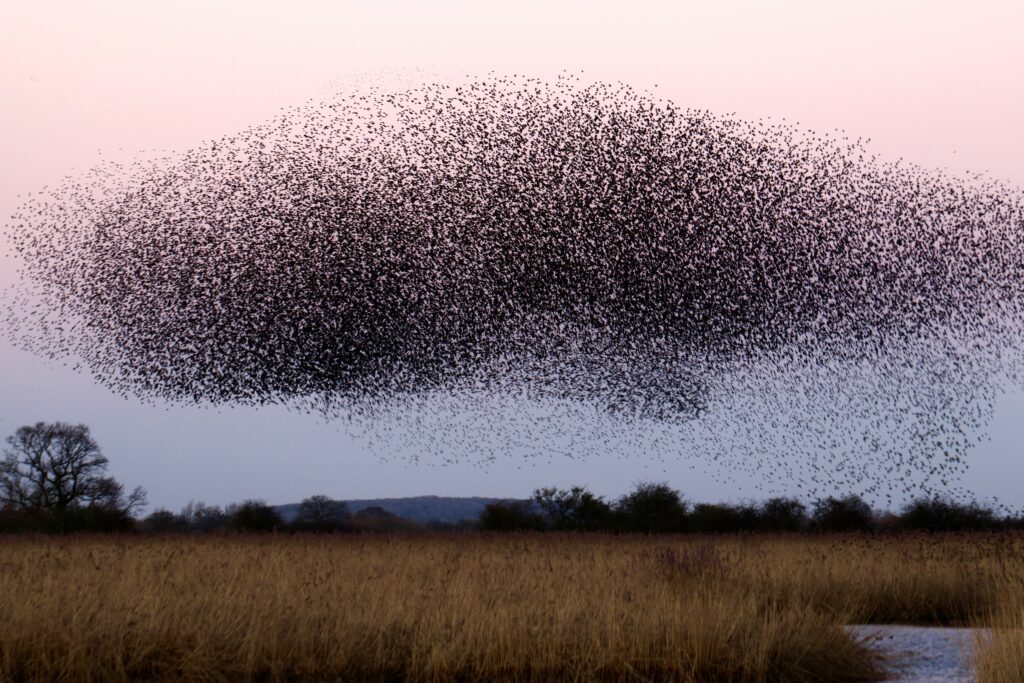
Now here’s where it gets exciting. What if we could design democratic institutions that actually worked like these successful natural systems? What if collective decision-making could be as smooth as the coordination you see in a murmuration of starlings?
This isn’t about replacing human judgment with computers. It’s about giving human collective intelligence the same kind of tools that make natural systems so effective. Just as GPS doesn’t replace your ability to navigate but makes it vastly more powerful, computational democracy could amplify our ability to think and decide together.
Picture this: instead of the current system where we argue past each other on social media and vote once every few years, we could have ongoing conversations where good ideas get refined and bad ideas get filtered out naturally. Instead of policies made by whoever shouts loudest, we could have decisions that genuinely integrate diverse perspectives and adapt based on real-world feedback.
The benefits would be tangible and immediate: faster responses to emerging challenges, policies that actually work because they’ve been tested and refined, institutions that get smarter over time instead of more dysfunctional. We could finally have democracy that feels as sophisticated as the technology in our pockets.
Building the Information Infrastructure for Collective Intelligence
How Nature Creates Intelligence Through Connection
Every successful coordination system in nature operates on the same basic principle: constant, meaningful communication between parts creates intelligence that exceeds what any individual part could achieve alone.
Your brain is the perfect example. Individual neurons are simple—they can only send basic electrical signals. But when billions of neurons communicate continuously, consciousness emerges. No single neuron understands language or recognizes faces, yet their collective conversation creates your ability to read these words and understand their meaning.
Forests work similarly through underground networks of fungal threads that connect tree roots. Trees share carbon, water, and even warning signals about insect attacks through these networks. What looks like individual trees competing is actually a collaborative network that makes the entire forest more resilient. When one tree is shaded and struggling, others can send it resources. When drought hits, the network helps distribute scarce water.
The immune system provides another model: millions of different cell types patrol your body, constantly sharing chemical messages about what they encounter. When they detect a threat, this distributed communication network rapidly coordinates a response. No central authority tells each cell what to do, yet they achieve remarkably sophisticated collective behavior.
The pattern is clear: intelligence emerges from connection, and connection requires continuous information flow.
The Power of Human Conversation
At the individual level, genuine conversation transforms both participants. When we truly listen to someone with a different perspective, we literally expand our capacity to understand the world. This isn’t just feel-good philosophy—cognitive science research shows that thinking extends beyond individual brains when we engage authentically with others.
Regular dialogue with neighbors creates something social scientists call “social capital”—networks of trust and mutual understanding that make communities more resilient and capable. But it goes deeper than that. Communities that engage in ongoing conversation about shared challenges develop collective intelligence that allows them to spot problems early, generate creative solutions, and adapt quickly to changing circumstances.
This mirrors how biological systems maintain health. Just as cells must constantly communicate to coordinate immune responses, communities need ongoing dialogue to coordinate responses to social challenges. One-off town halls or annual elections aren’t enough—we need the social equivalent of a nervous system.
When this works well, you can see it. Think of a neighborhood that successfully organizes to address a local problem, or a community that rallies together during a crisis. These groups didn’t just happen to be more organized—they had developed the conversational infrastructure that allowed collective intelligence to emerge when needed.
Scaling Wisdom: From Dialogue to Democracy
Here’s where computational tools become essential. The principles that work for small groups—continuous dialogue, information sharing, collective sense-making—can’t scale to complex societies through human conversation alone. We need technology to amplify human wisdom without replacing human judgment.
Imagine democratic processes that work more like healthy biological systems: continuous rather than episodic, adaptive rather than rigid, learning rather than repeating. Citizens could engage in ongoing dialogue about shared challenges, with AI systems helping to synthesize diverse perspectives, surface emerging patterns, and coordinate collective responses.
These systems could embody the same error-correction mechanisms that make natural systems robust. Misinformation would be filtered out through distributed fact-checking, while good ideas would spread and improve through collaborative refinement. The result would be institutions capable of genuine learning—able to update their approaches based on evidence rather than ideology.
This isn’t science fiction. Projects around the world are already demonstrating how computational tools can enhance rather than replace human collective intelligence. Digital platforms are helping communities engage in more sophisticated dialogue, AI systems are helping synthesize large-scale input into policy recommendations, and new forms of online democracy are allowing broader participation in complex decisions.
The path forward requires combining the best of human wisdom—our creativity, empathy, and moral reasoning—with the best of computational power—the ability to process vast amounts of information, identify patterns, and coordinate complex systems. This is how we build democracy that’s finally as sophisticated as the challenges we face.
People Know How.
On a mission to contribute in conceiving this missing infrastructure.
Recently I have been practicing being more real on LinkedIn. Stating the things that I think, in the language I think them, publicly on the internet.
I was wondering if LinkedIn is the place for these thoughts? Or if I should keep these for my blog.
To answer this; what is my purpose of having an active LinkedIn account? (Took me a moment to figure out)
Right now, I think it is to help me build and maintain an active network that is mission aligned. A network of people that also are working towards a better future for our planet – in whatever big steps they have the health to do so.
To reach this goal, I believe, it will help to be myself 🌳
However, there is already so much noise in the world. Especially now we are starting to pump AI generated crap into our society because it generates revenue on the short term.
If anyone thinks Dembrane is doing this exact thing, I would love to have a conversation with you! It is my biggest fear that Dembrane is doing this – but I am currently confident we are actually helping ensuring the peoples voice stays in our system.
So I will try to only post if I have the space in my life to say something meaningful. Could be every day, could be once a quarter haha – we’ll see.